Dirk Winterer
Discover how AFSM students turn their MBA consultancy projects into meaningful work — exploring leadership, strategy, sustainability, culture, and conscious management in action. Here you can read on how an AFSM MBA consultancy project on Gen Z workplace stress grew into a coaching framework for senior leaders and founder-CEOs.
The Inner Skills Gap That Drives Leadership Burnout Across Generations
The Swiss Job Stress Index, published by Gesundheitsförderung Schweiz, is the most precise measure of workplace stress in the country. The 2022 edition, the latest available, found that 28.2% of employed people in Switzerland were in a critical stress zone, meaning their workload significantly exceeded their available resources. That number had risen from 24.8% in 2014. And for the first time since the survey began, more than 30% of Swiss workers reported feeling emotionally exhausted.
The highest stress values were found among the youngest workers: those aged 16 to 24.
That statistic is where my consultancy project began. The question I wanted to answer was whether there was meaningful demand for a leadership development program designed specifically for Gen Z in Switzerland. The research confirmed the demand. But it also gave me something I had not gone looking for: a way of seeing the full arc of leadership stress, from where it starts to where it ends up, if it goes unaddressed.
The problem nobody was solving
The Gen Z workforce data is striking at scale. Deloitte’s 2025 global survey of 23,482 young people across 44 countries found that 36% of Gen Z respondents feel exhausted all or most of the time, and 42% say they often struggle to perform to the best of their ability because of burnout. In Switzerland specifically, 39% of Gen Zs report feeling stressed or anxious all or most of the time, and 40% say their job contributes significantly to those feelings.
Organisations have been trying to respond. In Switzerland, 55% of companies reported wanting to increase their involvement in workplace health management. Most of that focus lands on extrinsic measures: better working conditions, greater flexibility, mental health days.
The research I conducted suggested these are not wrong. They are just insufficient.
Through in-depth interviews with Gen Z participants, I heard a consistent pattern. Young people arriving in the workforce did not feel unprepared because they lacked technical knowledge. They felt unprepared because nobody had given them tools for the inside of the work: how to stay regulated under sustained pressure, how to motivate themselves from within rather than waiting for external conditions to shift, how to maintain a sense of purpose when the daily reality of a job does not match the meaning they came looking for.
A previous Deloitte study (2019) found that 49% of Gen Z participants felt unprepared for the workforce, and only 38% felt they had access to good mentors or role models. The interviews I conducted reflected the same picture. What was missing was not hard skills. It was self-directed capacity. The inner infrastructure of a working life.
The research identified three clusters of competency that mattered most: cognitive skills (how they think under pressure and complexity), intrapersonal skills (how they understand and manage their own states), and interpersonal skills (how they connect and communicate at work). All three were underdeveloped. None were being addressed systematically. Organisations were trying to solve a motivation and stress problem with structural changes, while the deeper need was developmental.
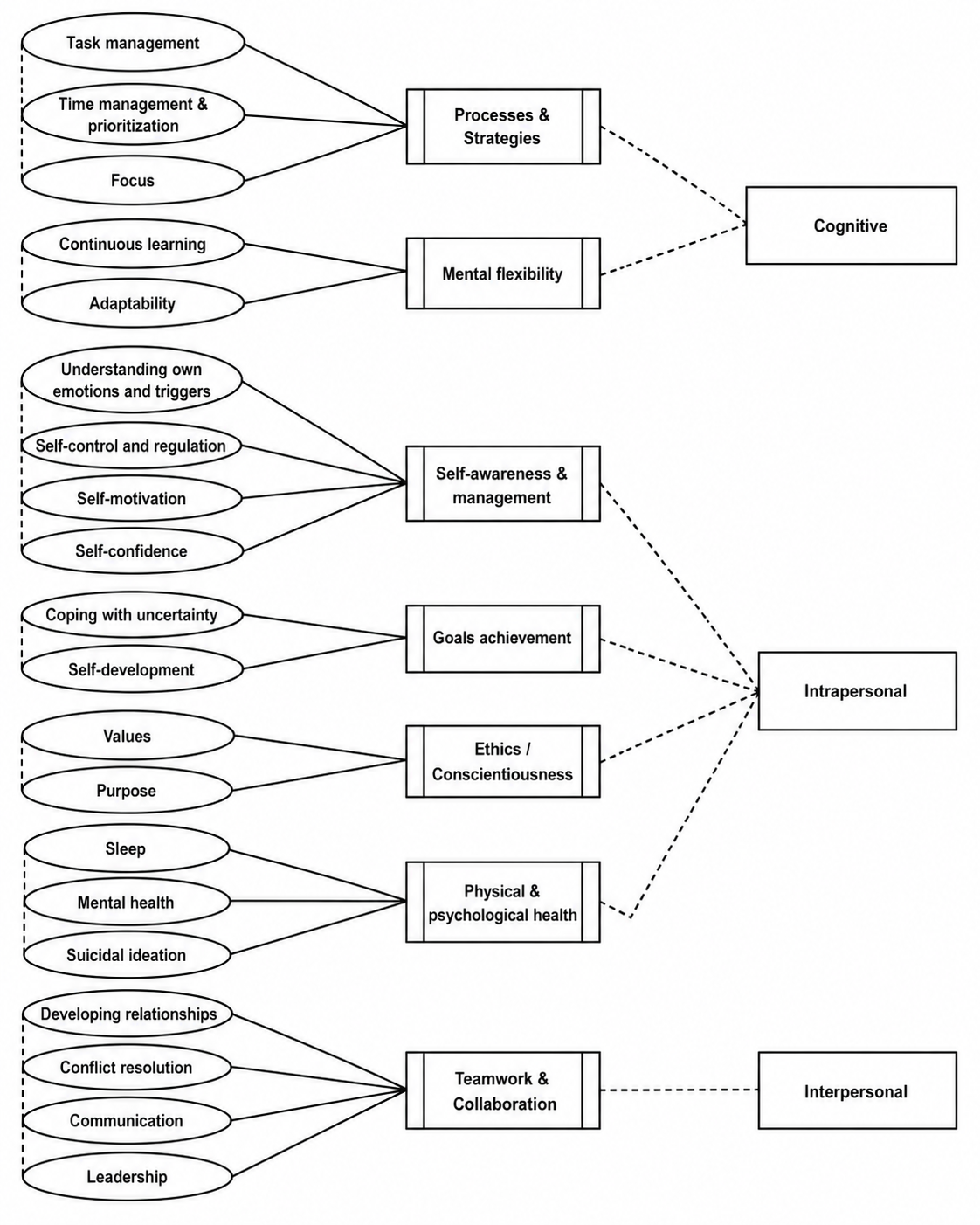
Figure 1: Code and Category Scheme
Herzberg’s two-factor theory has always pointed here: motivating factors are intrinsic. Extrinsic improvements remove sources of dissatisfaction. They do not create engagement. For engagement to exist, a person has to have a working relationship with their own motivation. That takes a different kind of development, and it has to come from within.
The consultancy project confirmed significant market demand for a program built around this. It also planted a question that stayed with me: what happens to these young people if the inner dimension of their work life stays undeveloped? Where do they end up, 20 years later?
The same pattern, two decades on
I have spent the years since my MBA building a coaching practice with senior leaders and founder-CEOs. What I encounter there, repeatedly, is a more advanced version of the same gap.
These are people who have performed at a high level for years, in many cases decades. The board is satisfied. The metrics confirm it. And something in them is quietly running down.
The 2026 Gallup State of the Global Workplace report put numbers to this: leaders today report substantially higher levels of daily stress, anger, sadness, and loneliness than the people they lead. At the same time, they rate their overall lives more positively. Their performance holds. Their experience of that performance deteriorates.
Boyatzis and McKee, researchers who have spent decades studying leadership and the nervous system, named this dynamic “power stress”: the chronic physiological cost of sustained influence, self-control, and responsibility. A leader’s cognitive and emotional resources are drawn on continuously. Decisions under uncertainty. Holding complexity. Staying present in high-stakes situations. Regulating how you show up for the people around you. Each of these is a genuine demand on the nervous system, and they compound.
The result, which Boyatzis and McKee call the Sacrifice Syndrome, is a self-reinforcing cycle: sustained demand produces diminishing capacity, which generates more effort, which deepens the depletion. The cycle stays invisible because performance continues to hold and the metrics still confirm it. For a while.
A 2025 LHH study of 2,675 executives across 10 countries found that leadership burnout had reached 56%, up from 52% the year before.
This is not a product of especially difficult years. It is what untreated accumulation looks like.
Here is the connection I keep returning to: the young person who enters the workforce without tools for their inner life does not leave the problem behind when they get promoted. They carry it forward. The cognitive and intrapersonal skills that were underdeveloped at 22 are still underdeveloped at 42, now carrying the weight of 20 additional years of leadership demand on top.
The stress that starts early does not resolve on its own. It compounds.
What I built in response
My consultancy project proposed a leadership development program for Gen Z in Switzerland. That work carried forward into my practice, in adapted form, as programs for younger leaders entering the workforce without the inner tools the role will eventually demand of them.
But the research trajectory led me somewhere else first. The pattern I kept encountering with senior clients demanded its own response.
The result is The Depletion CycleTM: a coaching framework for senior executives and founder-CEOs built around the specific sequence the research points to. Naming the pattern. Understanding the physiology behind it. Building the practices that activate genuine renewal. Assembling a system the leader can sustain independently, in the middle of a full professional life.
The work runs in small groups, by design. Honest reflection and peer recognition at this level of responsibility require real time and the right room. Both matter.
The research foundation is the same across both programs: Boyatzis and McKee’s work on resonant leadership, the neuroscience of the sympathetic and parasympathetic nervous systems, and the evidence on what actually reverses chronic stress. Rest, it turns out, does not. Renewal does. And renewal is a practice, not an event.
The population differs at each end of the arc. The underlying dynamic is the same.
What the MBA made possible
The MBA in Conscious Leadership at Alfred Ford School of Management gave me something I could not have built from consulting experience alone: a research framework serious enough to hold real questions.
The consultancy project forced me to work with evidence rather than assumptions. What I found in the data challenged some of what I thought I already knew. Gen Z was not primarily lacking hard skills. They were lacking access to their own inner resources. And the organisations they were entering were not equipped to give that to them either.
That finding shaped the two years that followed. It led me to Boyatzis and McKee, to the neuroscience of leadership stress, and eventually to a clearer articulation of a pattern I had been watching in coaching rooms without quite being able to name at scale.
The AFSM framework around conscious leadership gave me a specific lens: that who you are determines how you lead, and that strategy, execution, and performance follow from the leader’s inner clarity, not the other way around. The Gen Z research confirmed this at the entry level. The senior leadership work confirms it, daily, at the other end of the arc.
The research that began with Swiss job stress data ended up pointing at a human question that runs through every generation of leaders, from the first day of work onward: how do you stay connected to the inner life that makes leadership sustainable?
That question has no final answer. It has a practice.
A word for future students
If you are reading this as a current or prospective AFSM student: the work the programme asks of you is real, and it is worth it. The consultancy project, done seriously, is not just an academic requirement. Done honestly, it becomes a research foundation you carry forward into whatever comes next.
Mine led to a coaching practice, a specific body of work, and a clearer understanding of the problem I am here to address I did not know that when I submitted it in March 2023. I only knew I was trying to answer a question that felt genuinely important.
That is usually enough.
References
Galliker, S. et al. (2022). Job-Stress-Index 2022. Gesundheitsförderung Schweiz.
Deloitte (2019). 2019 Deloitte Global Millennial Survey. Deloitte Insights.
Deloitte (2025). Global 2025 Gen Z and Millennial Survey. Deloitte Insights.
Füllemann, D. et al. (2021). BGM in Schweizer Unternehmen. Gesundheitsförderung Schweiz.
Boyatzis, R.E. & McKee, A. (2005). Resonant Leadership. Harvard Business School Press.
LHH / The Adecco Group (2025). 2025 Views from the C-Suite.
Gallup (2026). State of the Global Workplace 2026.